

Code Quality: Why It Matters and How AI Can Help

Code quality isn't just about aesthetics or following best practices for their own sake. It's a fundamental aspect of software development that impacts everything from developer productivity to end-user experience. Let's explore why code quality matters and why detecting issues at the pull request stage can save you countless headaches down the road.
What is Code Quality?
Code quality encompasses several dimensions:
- Readability: How easy is it for humans to understand?
- Maintainability: How straightforward is it to modify or extend?
- Efficiency: How optimally does it use resources?
- Reliability: How consistent and dependable is it?
- Security: How well does it protect against vulnerabilities?
Why Code Quality Matters
1. Technical Debt Accumulation
Poor quality code is like taking on debt—it might seem expedient in the short term, but you'll pay interest in the future. Each time developers work with problematic code, they spend extra time understanding it, debugging it, or working around its limitations.
2. Developer Productivity
High-quality code enables developers to be more productive. When code is clean, well-structured, and follows consistent patterns, developers can navigate it quickly and make changes confidently.
3. Application Performance
Code quality directly impacts application performance. Inefficient algorithms, memory leaks, or unnecessary processing can lead to slow response times and poor user experience.
4. Reduced Bug Frequency
Better code quality typically leads to fewer bugs. When code is clear, follows established patterns, and handles edge cases, it's less likely to contain logical errors or unexpected behaviors.
The Pull Request Stage: Your First Line of Defense
Why PR Reviews Are Critical
Pull requests represent a pivotal moment in the development process—they're the last checkpoint before code enters your main codebase. Catching issues at this stage offers several advantages:
1. Cheaper to Fix
The cost of fixing issues increases dramatically the longer they remain in your codebase. A study by IBM found that fixing a bug after release costs 4-5 times more than fixing it during development, and up to 100 times more if discovered in production.
2. Prevents Problem Propagation
When poor quality code enters your main branch, it often becomes a template for future development. Other developers might copy patterns or approaches from existing code, spreading bad practices throughout your codebase.
3. Knowledge Sharing Opportunity
PR reviews aren't just about finding problems—they're learning opportunities. When reviewers identify quality issues, it creates a teaching moment that benefits the entire team.
4. Builds Team Ownership
When teams review code together, they build collective ownership of the codebase. This shared responsibility leads to better overall quality and consistency.
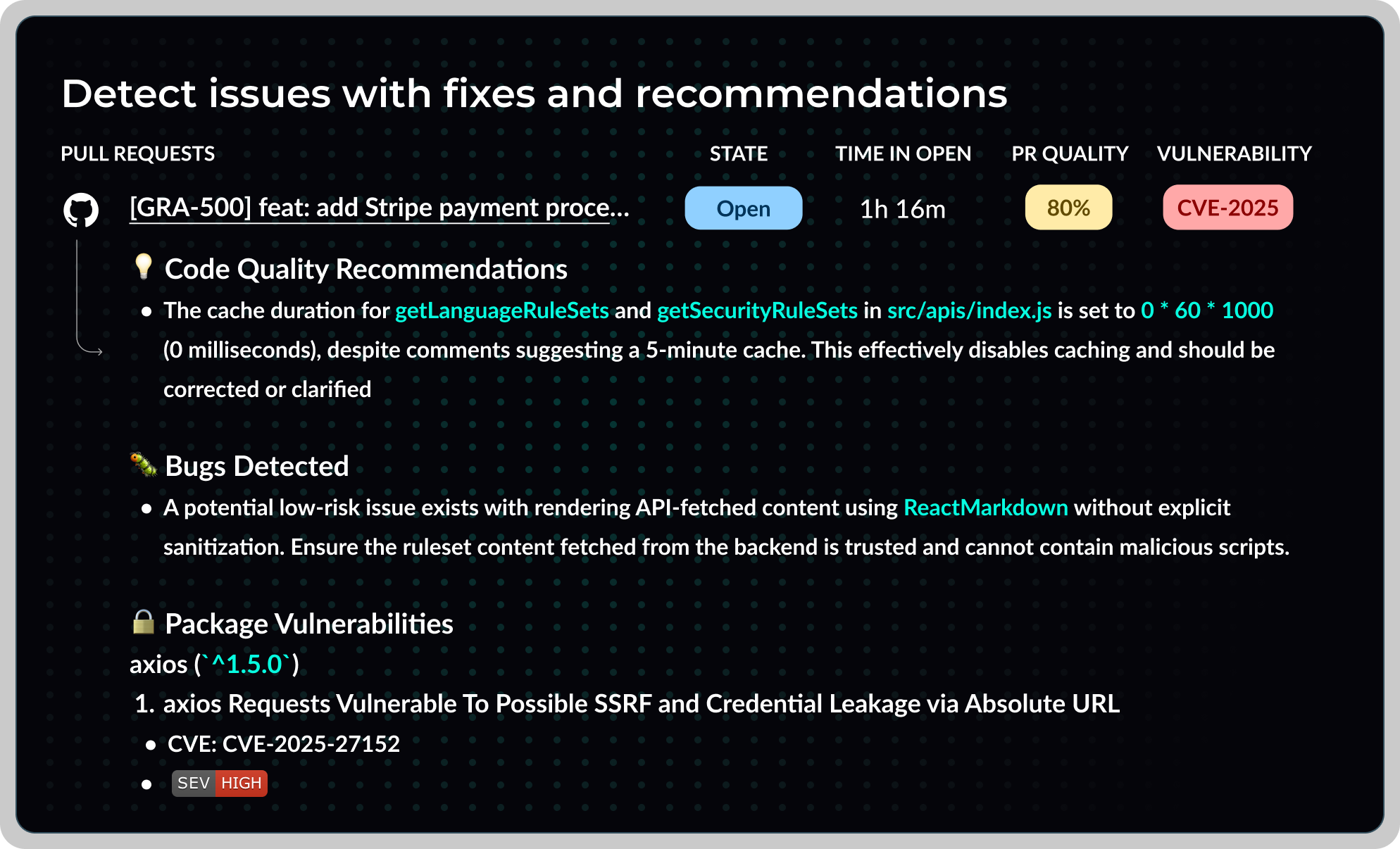
Practical Approaches to Detecting Quality Issues in PRs
Automated Tools
Leverage tools like:
- Static code analyzers
- Linters
- Performance profilers
- Automated test runners
- Code coverage reports
Human Review Practices
Combine automated tools with human intelligence:
Use checklists to ensure consistent review Establish clear quality standards Foster a culture of constructive feedback Practice pair programming for complex features
Moving Beyond "It Works"
The most dangerous phrase in software development might be "it works." This mindset prioritizes functionality over quality, ignoring the hidden costs of poor implementation. Instead, teams should embrace "it works well"—code that not only fulfills requirements but does so in a way that's maintainable, efficient, and aligned with team standards.
MatterAI builds frontier AI infrastructure for engineering teams — from inference-optimized models to autonomous coding agents and agentic code reviews.
Explore what we're building:
- Orbital IDE — Autonomous AI coding agent with background agents and deep codebase memory
- AI Code Reviews — Agentic pre-commit reviews across GitHub, GitLab, and Bitbucket
- Axon Models — Frontier-grade reasoning models at 70% lower inference cost
Share this Article:
More Articles
DSpark Speculative Decoding: How It Works & Speeds Up LLM Inference
Learn how DSpark speculative decoding accelerates LLM inference by 60–85% using semi-autoregressive drafting and confidence-scheduled verification.
Top 5 CLI Coding Agents in 2026: A Comprehensive Comparison
A deep dive into the top 5 CLI coding agents of 2026: OrbCode, Claude Code, Codex CLI, OpenCode, and Grok Build. Compare pros, cons, pricing, models, and wins to find the best fit for your workflow.
Data Annealing: The Hidden Optimization Layer Behind Modern AI Systems
Modern AI systems are no longer trained on static datasets. Frontier models continuously reshape, refine, replay, and optimize data throughout training — creating a new paradigm we call Data Annealing.
The Economics of AI Agents: How Companies Are Reducing AI Inference Costs by 70%
AI agents are becoming core infrastructure inside modern companies, but inference costs are scaling faster than most teams expect. Here's why AI agents become expensive — and how organizations are reducing operational AI costs by up to 70%.
How We Rebuilt the Context Layer Behind AI Code Review
Let's dive deep into the most advance and cost effective code reviewer
Continue Reading
DSpark Speculative Decoding: How It Works & Speeds Up LLM Inference
Learn how DSpark speculative decoding accelerates LLM inference by 60–85% using semi-autoregressive drafting and confidence-scheduled verification.
Top 5 CLI Coding Agents in 2026: A Comprehensive Comparison
A deep dive into the top 5 CLI coding agents of 2026: OrbCode, Claude Code, Codex CLI, OpenCode, and Grok Build. Compare pros, cons, pricing, models, and wins to find the best fit for your workflow.
Data Annealing: The Hidden Optimization Layer Behind Modern AI Systems
Modern AI systems are no longer trained on static datasets. Frontier models continuously reshape, refine, replay, and optimize data throughout training — creating a new paradigm we call Data Annealing.
Ship Faster. Ship Safer.
Join thousands of engineering teams using MatterAI to autonomously build, review, and deploy code with enterprise-grade precision.